
The difference between an agency you hire and a partner you keep

Most agency evaluation guides tell you what to look for in a pitch: check the portfolio, review the case studies, and look at their references. And they’re not wrong. All of these are good starting points.
But what those checklists rarely cover is whether an agency will stay engaged once the work begins. They don't show what happens when priorities shift and briefs need to evolve. Is that agency moving with you, or are they still stuck in how they were briefed on day one? This is usually where things can go sideways.
Finding the right agency is a bit like looking for a needle in a haystack. You know the right partner is out there, but you have to sift through a lot of hay first. The hardest part, though, isn’t finding the needle. It’s knowing if they’ll still be there six months later, when smooth-sailing campaigns give way to choppy waters.
We sat down with current and past clients to discuss the signals that helped them evaluate beyond the execution and find a partner worth keeping around day in and day out.
Does the agency start with the problem you need to solve?
A good discovery call should feel like you’re part of a whodunnit, and you’re the one under investigation.
The right agency should want to know everything. The business challenge underneath the brief, who you report back to, what you’ll be held accountable for, and what “this worked” looks like when you’re standing in front of your leadership team six months from now.
That’s how you know the agency is building a strategy for your situation, not recycling one from a previous client.
Before any agency starts pitching their capabilities, the best ones ask questions that help them understand what success looks like for you:
- Is there an approach you’ve been wanting to try but haven’t had the bandwidth for?
- If we could save you time on one thing, what would it be?
If you’re sitting in a discovery call and these types of questions aren’t being asked, pay attention. An agency that skips the problem-finding stage to get to the pitch faster is already making assumptions about your business. Those assumptions have a way of showing up later, usually at the worst possible time.
The takeaway: Before you open a single pitch deck, get clear on what you’re hiring for. Then watch whether the agency is trying to figure out the same thing.
Does their expertise fit your situation or just impress?
There’s a difference between an agency with a beautiful portfolio and an agency with the right experience for you specifically. Both can look identical at first glance.
The portfolio tells you what they’ve done. What you want to know is whether they understand your industry, your buyers, and the challenges specific to your business. And whether they have the insights to course correct when something isn’t working.
As you’re going through an agency’s work, these are the signals worth evaluating:
- Relevant experience, not just impressive work. Can you find examples of where they worked in your industry, with your type of buyer, in your market context? Pretty work in the wrong industry is still the wrong fit.
- Strategic depth. Can they explain why something worked, not just show you the finished deliverable. The thinking behind the deliverables is just as valuable as the output.
- Connected thinking. Do they track performance across a full campaign, or only the channels they’re directly responsible for? Agencies who only report on their own slice often miss the bigger picture.
- Honest self-assessment. Ask about a campaign that didn’t go as planned. How they talk about setbacks tells you more about how they’ll handle yours than any highlight reel will.
Here’s what this last signal looks like in practice for Delightful
During a marketing campaign focused on driving event registrations, paid social was performing well on the surface. Clicks were strong. Clickthrough rates looked good. But when clicks were mapped against actual paid registrations, we found a significant drop-off. This gap said something the top-line metrics didn’t.
The options were clear: either the ads were resonating with the right audience and something on the website was getting in the way of converting them, or the targeting was off entirely and people were clicking through only to bounce when they realized the event wasn’t for them. Two different problems with two very different fixes.
Once we confirmed the targeting as sound, attention turned to the landing page: the copy framing, the form length, any friction between click and completion. A few recommendations later, the second half of the campaign converted at a meaningfully higher rate.
The takeaway: An agency worth keeping will track the full picture, not just their corner of it. So, ask the probing questions when you’re evaluating their expertise. Their answers will tell you more than the portfolio.
How is the agency showing up before you’ve even signed?
This is one of the most underused evaluation tools you have, and it’s available from the very first conversation.
The way an agency communicates during the pitch process is a preview of how they’ll communicate when you’re a client. Are they responsive? Do they listen more than they pitch? When you ask a direct question, do you get a direct answer?
Communication patterns don’t improve after you sign. They become more visible.
What you want to see is an agency that treats the pitch itself as a collaboration. Not a presentation they’ve rehearsed and are delivering to you, but a conversation where they’re genuinely curious about your situation and thinking through the problem alongside you.
This is one of the biggest differences between an agency that’s selling and an agency that’s already working. The ones that will be true partners show you exactly how they’d show up as your partner in how they run the discovery call, how they follow up with you, how they collaborate to arrive at a final scope of work. If the pitch feels like a one-way download, the engagement probably will too.
As you decide, try testing them by introducing a complication. Change the timeline, add a constraint, or ask for something they didn’t prepare for.
The takeaway: How an agency responds to friction and uncertainty before you’re a client is one of the clearest signals you’ll get about how they’ll handle things when you are.
Will their reporting help you make better decisions?
Reporting and strategic insights are one of the areas where agency relationships most often start to fray. And it’s rarely on the evaluation checklist.
Every agency will tell you they’re data-driven. What you want to know is whether their reporting will help you make better decisions, or whether it will mostly generate activity updates that look thorough without telling you what to do next.
There’s a big difference between the two. One keeps you informed. The other keeps you busy.
Good reporting connects the work to business outcomes, not just impressions and clicks, but movement on the things your business cares about. This could be pipeline, revenue, audience quality, or whatever success criteria you defined at the start.
When you’re evaluating, ask to see a sample client report. Ask what metrics they’d recommend tracking your specific goals and why. Ask how they communicate when results fall short and what their process looks like for course-correcting.
The takeaway: You want a partner who keeps you informed as the work progresses, helps you interpret what the data means, and brings recommendations to you rather than waiting to be asked. Because the reporting isn’t just for you. It’s what you bring to your own leadership, and it needs to be clear, honest, and defensible.
Is the agency bringing the right tools into your work, or leaving you to figure it out?
Marketing trends move fast; AI tools even faster. One question worth asking is how they’re keeping up with AI, and more importantly, whether they’re bringing that thinking into your work or leaving you to navigate it on your own.
There are two ways agencies can get this wrong. Some ignore AI-powered tools entirely, falling behind on efficiency and what’s possible for their clients. Others overcorrect and lean on automation as a substitute for thinking, producing work that’s technically competent but missing the judgment and creative instinct that makes it land. What serves you best is an agency that uses AI to accelerate the speed of work and then applies a sharper human layer to everything that requires strategy, context, and decision-making.
But the right agency isn’t just using AI internally. They’re helping you think through where it fits in your work, too. Part of being a true partner is understanding not just where marketing and communications can support your goals, but where AI tools can solve the challenges in between. Whether it’s the workflow gaps that slow your team down or the recurring asks that don’t fit neatly into a brief. A good agency will surface those opportunities and help you figure out what to do about them.
Here’s what this looks like in practice for Delightful
On our executive communications side, we use an AI agent built for content creation. It draws on everything we’ve learned about an executive’s voice, focus areas, and the angles that resonate with their audience to get to a strong first draft faster.
But the AI is just the starting point. Our team brings the editorial judgment, the tonal read, and the strategic framing that makes the difference between content that sounds like the executive and content that sounds like them on their best day.
The efficiency gains free us up to focus on getting the message right for the moment, the audience, and any other elements the client needs to navigate.
When you’re evaluating an agency, ask how they’re integrating AI into their own workflows and how they’re helping clients think through AI adoption in theirs. The answer should describe a clear division of labor, where the tools create capacity, and the people bring judgment that tools can’t replace. If they can’t articulate that distinction, you’re either working with an agency that hasn’t figured it out yet or one using AI as a shortcut rather than a foundation.
The takeaway: AI in the right hands creates space for better strategy, faster delivery, and a partner who shows up with more to offer, including helping you figure out where AI can work for you. In the wrong ones, it’s just automation wearing a strategy hat. Know the difference and which version ultimately works best for your needs.
What are the green and red flags to look for?
Even when everything looks good on paper, the final filter is behavioral. Here’s a quick guide to what you want to see, and what should give you pause.
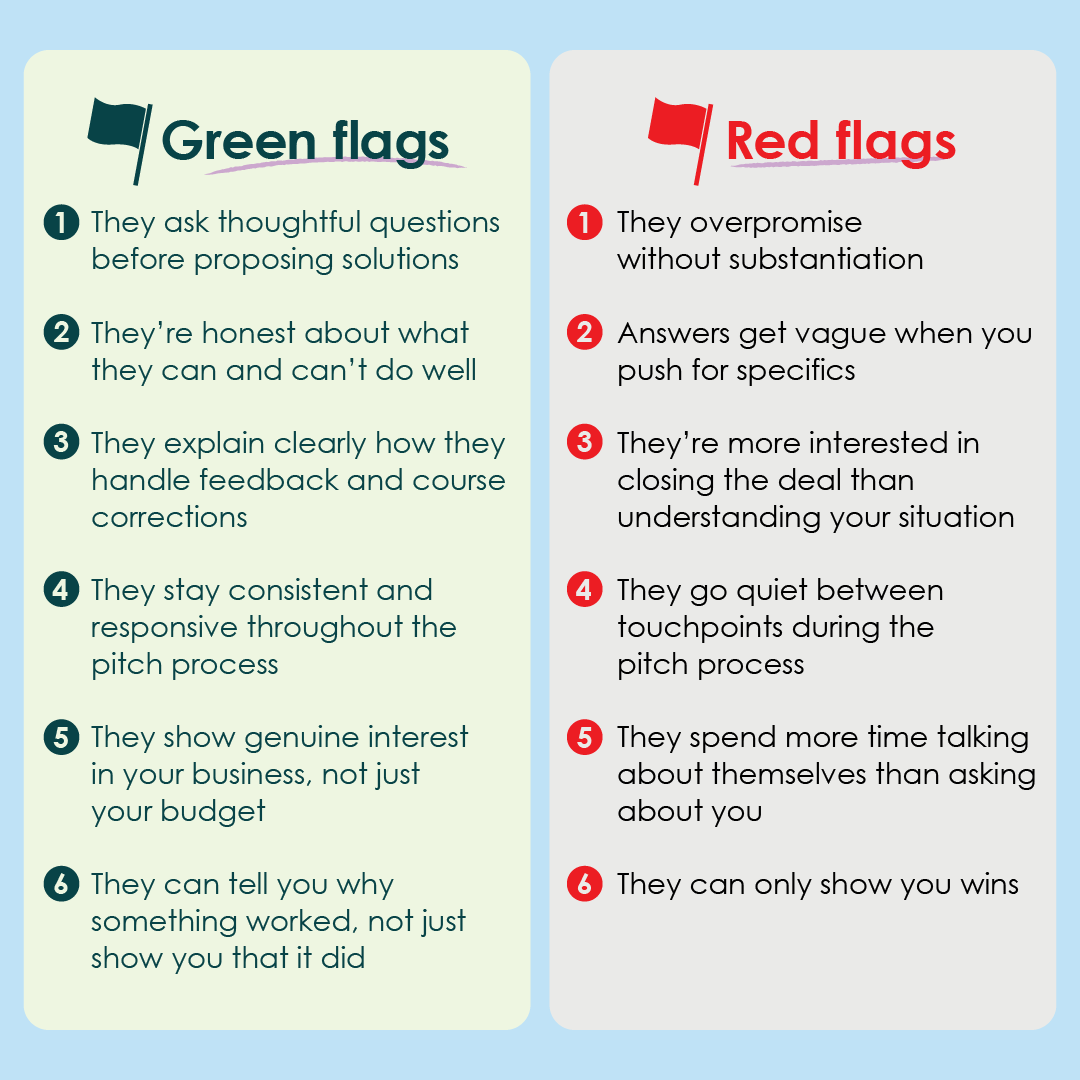
One more test worth running: after the formal pitch process, reach back out with a follow-up question that’s a little outside what was covered. Something open-ended that requires them to think rather than pull from a deck. The response, and how quickly it comes, tells you a lot.
What does it feel like when you’ve found the right partner?
There’s a version of agency partnership that most people don’t know to look for until they’ve experienced it.
It shows up when you’re walking into a leadership presentation and you know the numbers cold because someone helped you understand them, not just compile them. It shows up when the market shifts and there’s a team already working through what that means for your strategy before you’ve had to ask. It shows up when a question comes from your leadership team that you weren’t expecting, and you have an answer because you weren’t navigating it alone.
The best way to describe it is quiet amplification. The agency isn’t in the room to take credit. They’re there so you and your team can walk in prepared, confident, and clear on what the work is delivering and why. Their success is measured by how well yours goes.
A true agency partnership should look like a working relationship that’s useful when things are running smoothly, and especially useful when they’re not. An agency that executes and disappears isn’t a partner. A partner is the one who’s still there on the hard days, helping you figure out what comes next.
Ready to find your needle?
At Delightful, this is how we show up. From the first conversation through strategy, execution, reporting, and optimization, we stay involved because the moments that test a partnership are not always the ones you plan for.
If you want to see the kind of work we deliver for our clients, check out our work page. And when you’re ready to talk through what the right partnership looks like for your brand, hit the 'Let's Talk' button below!